Whenever or do we ever discuss the CPF system with friends and family. The actual fact is that I never really do unless it is time to do something about it. That involves tax season or even property tax season. I do feel that it is a system that we think we all know but once we delve deeper, there’s always something new to takeaway.
Let us also face it. It is a dry topic and a very long-term one. It tries to mimic a pension fund of some sort with some level of control yet it works differently for different people. I can understand why some people come to dislike the policy but in general, there’s not much hate around it. We also have to be factual that Anti-government does not mean you need to be anti-CPF. Some might differ but I think all tools that bring one to the final goal are the ultimate endpoint.
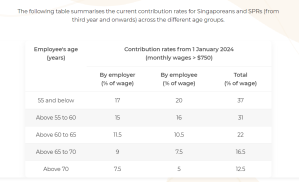
Contribution rates according to age and wages
The rules are pretty simple. Understanding that before 55 years of age, all employees have to contribute 20% of their gross salary. Subject to the ordinary wage cap which we have discussed previously.
After 55 years of age, the contribution starts to decrease. This makes sense since the decrease in employer contribution, older employees will become less expensive and it helps to make employment more affordable.
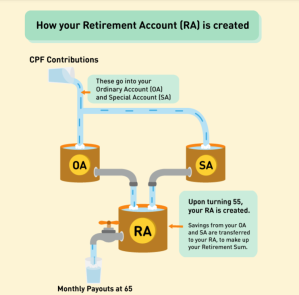
After 55 years of age, the OA and SA will be combined and set aside in one’s RA to safeguard a monthly payout in the later years. This is probably why the contribution rates start to decrease then. Further, with increasing age, the focus will be more on wealth preservation and income that can be utilized. That would be the next reason why the contribution is lesser as time goes by.
Contribution by age from the CPF website
Understanding the CPF – Did you know? What contributes to your CPF?
Understanding that CPF system – These mainly include all forms of payments that are paid out to the employee by the employer.
Basic Wages
Overtime Wages
Bonus
Cash Incentives
Commissions
Cash Incentives
Understanding the CPF – Did you know? What does not contribute to your CPF?
Termination/Retrenchment Benefits
Reimbursements
Benefit in kind
Disclaimer
If you like what you are seeing, do remember to check them out and do your diligence. There is no one-size-fits-all investment strategy and no one solution to life. Join my telegram group to find out more about deals and join the community to connect for ideas: Life Journey Telegram
If you like what I am sharing or if it resonates with you, do use my referral codes here at Referral Services
It is very interesting to know that many people are interested to know about the CPF. Hence, I’ve decided to do a simple part series that focuses on selected and focused information so that it doesn’t take too long to read and understand. In my previous CPF series, we discussed the increase in CPF contribution on Ordinary Wages aka Salary.
CPF is a complex retirement module indeed and it has different accounts. CPFIS in turn has its pros and cons. One needs to understand it to use it to your own advantage. Most of these come at retirement as a motivation or tax deductibles. That said, it works differently for everyone so good to be in the know. One can be anti-government but we should applaud a strong and stable governance. This in turn will relate to a trusty CPF system not everyone can replicate.
Types of CPF account and what they can do
Ordinary Account:
Be happy retiring and be happy doing what you do when you retire
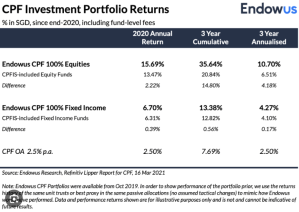
Though CPF is restrictive OA is the most flexible out of all three accounts before one turns 55. This is the account that one can use to invest a portion into selected CPF-approved investments (CPFIS), gold, approved insurance, and also property payments. One can look at index investing using a Robo Advisor of some sort. such as Endowus or StashAway. Endowus ticks a little better for me for the investing portion. If we look at the iShares US index Fund S&P 500 that Endowus offers to track the S&P500 (100 years of historical performance). I also have my funds consistently invested in them and it has worked well. What I really like is that they care about who invests with them and the fees.
You can check them out here at Endowus or in my previous posts which I slowly grew to like over 2 years. Asset Allocation does not time the market and during times when I’m distracted, I do not need to log into my app to proceed with my own adjustments or take action. (These take time and effort)
Asset Allocation
Special Account:
This account builds the Retirement account that will eventually be used in the retirement account in the form of an annuity. More restrictive than the OA, it has limits and can only be utilized for retirement-related financial products (Nothing much can be done in this account) It is also known that OA can be transferred to MA – This is well known to be irreversible once you have done so. Do consider your circumstances before you do anything)
Medisave Account:
This is the most restrictive of all and as it states Medisave means it can be used for certain medical payments with a limit. The MA account is also allowed to be used to purchase medical-related insurance.
Retirement Accounts
Retirement Account:
This account is non-existent until you reach 55 years of age at the point of writing. This is the combination of your OA and SA to form the annuity payout.
There are also many ways for one to contribute to your own CPF accounts. I’ll say it is a good problem to have if you need to think of fresh ways to contribute to your own CPF funds. (i.e. self-employed and looking for proper and forced retirement). Side note that CPFs are monies that are locked away in the form of something like a trust so one can’t claim your assets in your CPF (If for some reason, you are locked up in a situation of some sort)
Some ways to look at contributing to your CPF accounts
Make cash top-ups or Top up Cash + CPF
Your OA, SA, and MA – through these cash top-ups, you can earn interest. Note that these are long-term retirement uses.
Can’t say that too many times if you want to do forced savings.
Matched Retirement Savings Scheme (MRSS)
If you’re 55 to 70 and have yet to meet the current Basic Retirement Sum (BRS), you can make cash top-ups to get higher retirement payouts. The Singapore Government will match every dollar of cash top-ups made to your RA, up to a maximum grant of $600 a year. The scheme will run from 2021 for five years for a start. (Taken from the CPF website)
Helping your parents or in-laws with the CP scheme helps you and the older folks as well.
Invest your OA savings
We discussed the option of investing in a wide range of investments to grow your retirement nest egg in the form of the CPF Investment Scheme which is very highly restrictive.
As for SA, you can invest in those too but even more restricted.
Voluntary Housing Refund
If you have used CPF to purchase your house and have excess cash. One way is to kind of payback voluntarily. However, recently the cash returns outweigh that of CPF returns so with careful management, it does seem like it is better to hold cash but it is a better yielding instrument for now.
Too complicated? Leave it as it is and put the cash via this method to earn that CPF consistent return.
For CPFIS/Investing – The reason for Endowus
Like a broken recorder, why do I like using them for now:
Endowus is the first and only robo-advisor to be approved by the CPF board.
100% trailer fees back to the consumer, not the fund management fee. This is really one of a kind I’ve seen so far.
They do have a decent team that makes sense when introducing their platform in my personal opinion.
I believe all retail investors should try them out because of how they are trying to disrupt investing and make investing work for everyone.
If you like what you are seeing, do remember to check them out and do your diligence. There is no one-size-fits-all investment strategy and no one solution to life. Join my telegram group to find out more about deals and join the community to connect for ideas: Life Journey Telegram
If you like what I am sharing or if it resonates with you, do use my referral codes here at Referral Services
Happy 2024 everyone! Everyone knows 2024 has a staggering change in CPF and the government has done that to help businesses to adapt. It is strange though that the last post about CPF had a bit of viewership. Perhaps the interest in CPF has really changed over the years.
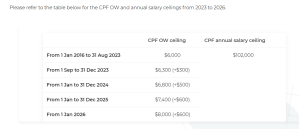
Last Sep 2023, the salary cap (OW) was increased to SGD 6,300, and from 2024, there will be an increase to SGD 6,800. What that means is that more of the money that you earn goes into your CPF aka retirement account every month. Your employers will also have to contribute more to your CPF. I can’t say if that is a good or bad thing.
I guess we are touching on a sensitive part of everyone’s life. Your Salary. Salary are always a sensitive part of most people’s discussions. However, these are all hard truths that we have to come to terms with. Some people do have that special negotiation skill to make more while doing the same thing. We just have to work more productively.
Sidetracking a little, everyone is a salesperson to themselves so don’t say that you don’t do sales. When you go for a job interview, you are selling yourself for the package that you think you are worth. You will need to justify your costs to the hiring manager.
Back on track again, today we are focusing on the monies that go to your CPF. Regarding the monies on CPF, please note the statement on the CPF website that states that:
(a) The CPF Ordinary Wage (OW) ceiling limits the amount of OW that attracts CPF contributions in a calendar month for all employees. The OW ceiling will be raised from $6,000 to $8,000 by 2026, with the first increase to take place on 1 September 2023. The increase will take place in four steps to allow employers and employees to adjust to the changes.
This means that the changes are made to let business manage their cashflow instead of a bang…a 2k addition to employers’ contribution and less take-home pay for the employee (Since 2023 costs, inflation, and goods have all increased)
(b) There will be no change to the CPF annual salary ceiling of $102,000, which sets the maximum amount of CPF contributions payable for all salaries received in the year, inclusive of both Ordinary Wages and Additional Wages.
This actually means that people who have more resources than the rest will not be able to game the CPF. This is pretty fair in my opinion since this is a tool to help Singaporeans whether they have little or a lot more resources. However, the truth is also that when you have more, there’s more that you can do that others can’t. The only takeaway is that the rich get richer but only at a cap.
(c) There will be no changes to the Additional Wage ceiling and CPF Annual Limit, where they will remain at [$102,000 – Total Ordinary Wage subject to CPF for the year] and $37,740 respectively.
Same points as (b) above. There’s that cap that restricts more from getting more if you know what I mean.
I’m quite sure everyone is aware of this but probably left that somewhere. I’m just bringing it back since the changes took effect this year. I took this off the CPF website where the Salary OW cap process will happen.
Just a disclaimer that everyone’s situation is different here so it is important to stay in the know so that you can plan your finances in advance. As the saying goes, if you fail to plan, you are planning to fail:
This is something one cannot control. Employee or Employer. We can only embrace the change.
Let’s look at it positively. This will compound interests for many and help build or supplement the CPF retirement nest.
My thoughts are that this actually does hurt business owners a little more. Over time, these staff costs will indirectly translate into services, items, goods, and whatever is sold to consumers or businesses.
In my next CPF series, I will share or talk about CPF programs and how to help your parents or elders who do not believe in CPF (Or rather too complicated to understand) You just don’t reject free money.
Disclaimer
If you like what you are seeing, do remember to check them out and do your diligence. There is no one-size-fits-all investment strategy and no one solution to life. Join my telegram group to find out more about deals and join the community to connect for ideas: Life Journey Telegram
If you like what I am sharing or if it resonates with you, do use my referral codes here at Referral Services
Happy Friday. My mood is getting better by the day because I have clarity over what I have to do with my life in the next few weeks. I believe everyone has received their CPF interests. Some people have a lot more while others are just started out. I understand human psychology makes you a bit more envious than others. Not many people can shut the noise out. Here’s what I am going to do. You need to learn to cut it out because you are you. Not to worry, we must believe that we can do a lot more.
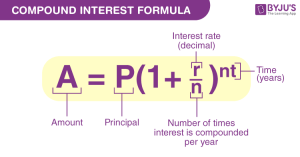
Today’s focus will be on deductibles for your CPF. This is not for everyone but it is good to know. It may not apply to you today but it will some day so be in the know. By now, if you are looking through tax deductibles via CPF, you would have known that 1st Jan 2024 is a great time to receive interest in your CPF account. Slowly but surely, your CPF will compound. In my very early days of financial blog, I talked about the power of compound. Do refer to that and you can see how powerful it is and time flies very quickly.
Compounding interest (Image from BYJU)
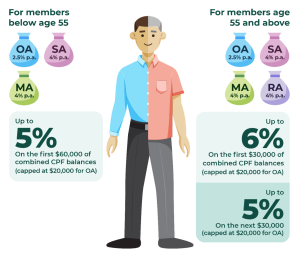
Where do your CPF monies go
CPF is divided into OA, SA, and MA and apportioned according to your age. If you have planned it well by some time, you would have maxed out FRS in SA and the cap at MA. The interest portion that you received will not flow into your MA but goes to the other accounts and if you hit your SA, then it goes only to your OA. That means that by contributing cash to your MA or what we know as a top-up. That helps in your tax deduction for the year.
Usual years – likely due to normal inflation rates, the top as projected is about 2 to 2.5k every year. As of 2024, one can top up to 3k in the MA. That helps with tax deductions.
Just a disclaimer that everyone’s situation is different so you have to consider some factors:
Do you have a mortgage that you need to pay from your OA?
Did you use any CPF monies for T-bills. If you need cash flow, then you have to plan it out.
Do you require liquidity? CPF Is an irreversible process until you reach the statutory age of 55 or longer.
If this does not apply to you. Just be in the know, let it be a motivation.
Disclaimer
If you like what you are seeing, do remember to check them out and do your diligence. There is no one-size-fits-all investment strategy or general rule for your every life. Join my telegram group to find out more about deals and join the community to connect for ideas: Life Journey Telegram
If you like what I am sharing or if it resonates with you, do use my referral codes here at Referral Services
On 4 November 2022, 3 working days after OCBC rolled out their new interest rate on their flagship 360 accounts, DBS followed up with an email that the DBS Multiplier has increased from 3.5% to 4.1%. The balance cap amount is also increased to S$100,000
The Multiplier account has always been proportioned by the transaction amount.
below S$2,000
S$2,000 to below S$2,500
S$2,500 to below S$5,000
S$5,000 to below S$15,000
S$15,000 to below S$30,000
Above S$30,000
The next layer of categories to fulfil will be the number of categories. They are known to be:
1. Salary/Dividends/SGFinDex
The Salary portion has to be a GIRO transaction with code “SAL” or “PAY”, which seems pretty strict given that there are increasing numbers of the next generation in the ‘gig economy’
For dividend crediting, these eligible dividend has to be from CDP, DBS Vickers Securities, DBS Online Equity Trading, DBS Unit Trusts, DBS Online Funds Investing and Invest-Saver (Promotion their own eco-system)
Connecting and sharing financial information from SGFinDex to NAV Planner (I would think one needs to do this on a monthly basis
2. Credit Card Spend
For the monthly card spend, it has to be on any DBS credit card and has to be eligible spending. Eligible will be the usual suspects and it will be very much dependent on the MCC codes.
3. Home Loan Installment
Home Loan financing has to be from DBS or POSB (New or Refinancing). The eligible amount will be from the monthly home loan instalment amount.
4. Insurance
Similar to my previous post on insurance and investment in these high-yield accounts. These are usually valid for a limited period and interest rates are always subject to changes. Further, only selected insurance are eligible.
5. Investment
Nothing much to comment on here. This section will be pretty hard for most people to fulfil.
Additional option: The PayLah! Retail Spend. Honestly, don’t seem like a good deal to me.
The ideal interest rate will be between 0.9% to 2,5%. Frankly, nothing much has changed though and I don’t think it is even worth announcing via their communication channels. I feel like there wasn’t even much thought placed into it. I just felt like it isn’t any effort to compete with these changes. With the most recent 0.75 bps increase by the US Feds, this is not anything competitive and not quite worth looking into for now.
The week has been intercepted by headline interest rate hike news and OCBC 360 certainly did take out their competition with a banging headline. As of the 1st of November 2022, the entire suite of the OCBC 260 flagship account will revise its interest rate across the board.
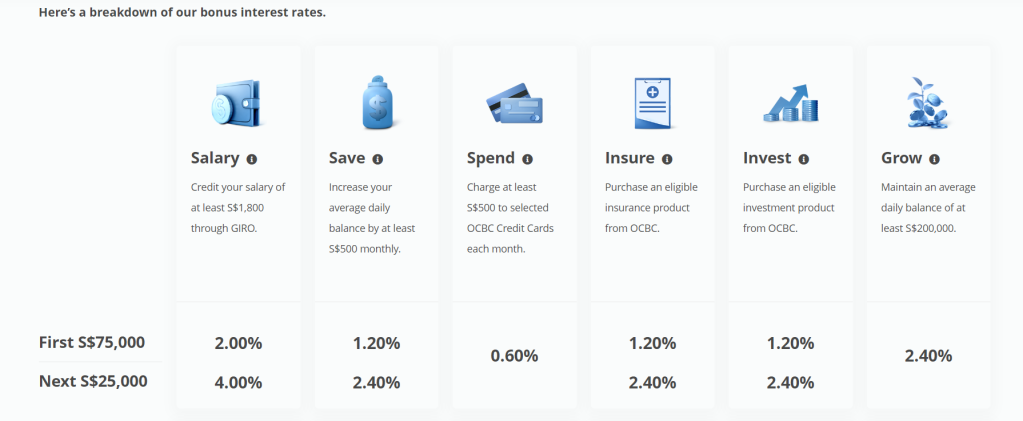
As of their online quote, “The OCBC 360 Account has six bonus interest categories – Salary, Save, Spend, Wealth (Insure), Wealth (Invest) and Grow. By tapping on just three of these categories – Salary, Save and Spend – customers will be able to earn interest of 4.65% p.a. on the first S$100,000 in their bank account.”
Prior to this due to the interest rate environment, the first S$100,000 could get you 1.85% p.a. The biggest update is that for their spending options, you can use the OCBC 365 credit card, OCBC Titanium Rewards credit card, OCBC 90°N Visa card and OCBC 90°N Mastercard.
There are a total of 6 categories:
Salary, Save, Spend, Insure, Invest and Grow.
The basic of the high-yield account is to fulfil the following – Salary, Saving (Keeping the average daily balance by $500 increment monthly) and spending S4500 to the above-mentioned OCBC credit card each month. Quite simply put, by fulfilling these three options, your interest yield is 4.65% p.a. for up to $100,000. (technically 4.64962903% p.a.)
Over 365 days, the interest earned is S$4,649.63
Salary
You need to credit at least S$1,800 of your salary to fulfil the Salary Category. That is if your HR allows that or if you are not employed in another rival or financial institution.
Save
You need to have an incremental S$500 in your monthly balance. However, if this is your transaction account then it might be an issue. But as long as it is an incremental (Average daily balance)
Spend
You need to spend S$500 on selected OCBC credit cards. You can use the OCBC 365 credit card, OCBC Titanium Rewards credit card, OCBC 90°N Visa card and OCBC 90°N Mastercard.
Insure & Invest
Forget about the insurance and Investment portion, there’s probably no way around those.
Grow
For the Grow category, if you have an additional S$100,000 to keep the average daily balance of S$200,000, the first S$100,000 will get an additional 2.40% p.a. while your remaining S$100,000 remain at the 0.05% p.a.
To illustrate, the interest over this S$200,000 will be S$7,099.60 hence the yield for this amount will be 3.55% p.a. (technically 3.54980161% p.a.
To calculate your interest amount, use the link to calculate the expected interest on your saving amount here: Calculate your Interest Amount
Conclusion
This is very interesting indeed. Because competitors will drastically make these changes as well. The interest rate hike might be a good and bad thing. However, take note that these rates are never confirmed or fixed. They follow the current market conditions. By taking on investments or insurance, these interest rates might change fast and furious. Overall, valiant effort and quite good timing as well. In the next few weeks, we might see revisions to compete with this increase in interest rate.
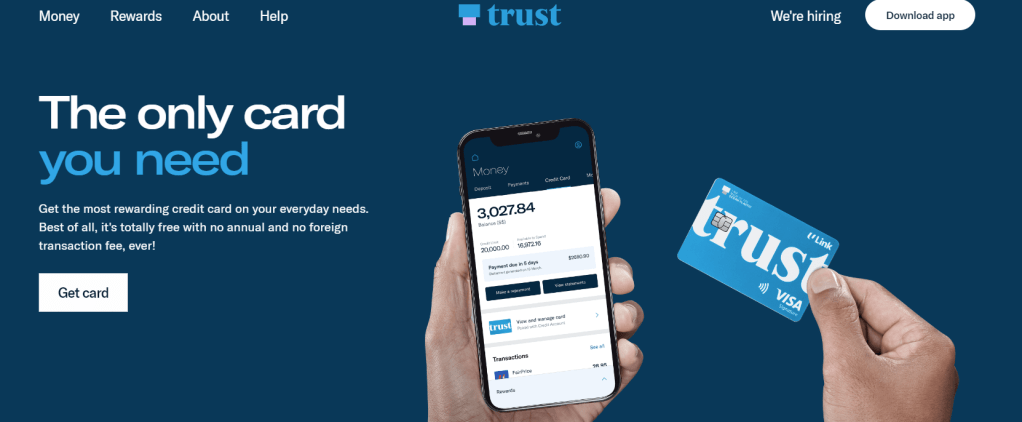
Quick update on the recent spate of changes regarding bank interest rate changes. I decided to take on a review of all the interest rate reviews that I’ve picked up over time. The first of this series will be from Trust Bank. If you did not know, Trust Bank is a digital bank that is in collaboration with Fair Price Group X Standard Chartered Bank Singapore.
All right, if you have not signed up for this Trust Bank Freebie, I think it is still available now. Please do sign up using my referral code “MREC9F7G” at Sign Up here at Trust Bank
a. You will get a $10 fair price voucher that you can use when you visit any Fair Price Supermarket outlet.
b. You will get an additional $25 fair price voucher once you make your first spend on your card (no minimum spending amount) Pretty sweet, I would say.
c. On top of that, you get some perks of free coffee when you go to Kopitiam to name a few.
At a first glance, I didn’t really like the logo and branding. It does feel too corporate and dated but that is my own opinion
Next, I always believed that all new businesses should be revolutionary from traditional ones. I expect no less from digital banks. Instead of making things easy to understand, It seems like it isn’t too simple. I’m a simple person, if I don’t understand, I think most people don’t and will not bother to find out more. I don’t really know how is it like in terms of their sign up but I’m pretty sure it has stagnated.
In any case, Just see it as Bank Account and Link Point Reward for simplicity.
Bank Account
For Bank Accounts, you will get a base of 1.5% for amounts up to SGD 75,000.00 (In any case, they are also SDIC insured for up to the same amount of SGD 75,000.00)
If you spend 5 transactions on your Trust Credit Card Every month, you will get an additional 0.5% for amounts up to SGD 75,000.00 and hence your total interest is 2.0% p.a.
If you are a Union member, the 0.5% is upgraded to 1.0% and hence your total interest is 2.5% p.a.
a. You will save up to 21% (Credit Card) worth in rewards for a total spend of 350 monthly on that card other than at FairPrice Group, which is in summary
2.5% base rate (Earn unlimited savings of 0.5% on FPG groceries^ and 0.22% on all other eligible spend^^. Exclusive for FairPrice members only! Earn an additional 2% on FPG groceries^, capped at 12,000 Link points a year)
This spending on the above-mentioned has to be on FairPrice Group purchases only.
8.5% monthly bonus (Earn 8.5% on FPG spend^^^ when you meet a monthly minimum eligible spend of S$350 outside of FPG, capped at 5,500 Link points)
You need to spend $350 monthly outside of FairPrice Group spending.
8.0% quarterly bonus (Earn 8% on FPG spend^^^ when you meet your monthly minimum eligible spend for 3 consecutive months, capped at 7,500 Link points)
This quarterly requirement has to be fulfilled for 3 consecutive months, otherwise, that is a fit fat 0.
2.0% FairPrice annual member bonus (Earn 2% once a year on FPG groceries^, capped at 12,000 Link points)
Really not too sure if the 12,000 link points cap is inclusive of the link points earned a year or separate. This is why I really dislike complicated rewards programmes.
b. Up to 11% savings (With the debit card) I suppose this is for customers who are ineligible for the credit card. I shall not dwell on this. You can click on the link above to read more. My question is really that if the digital bank is to serve the underserved, then why penalise those who can afford a credit card. Also, if aunties and uncles are the targets, maybe online is not the best way to go for now.
All these may change at the end of 31 December 2022. Note that there is a cap of 12,000 Link points per annum. I don’t really like the cap on rewards. It is just too troublesome.
Pros
What is good is that there isn’t any lock-in period, it works just like a saving account
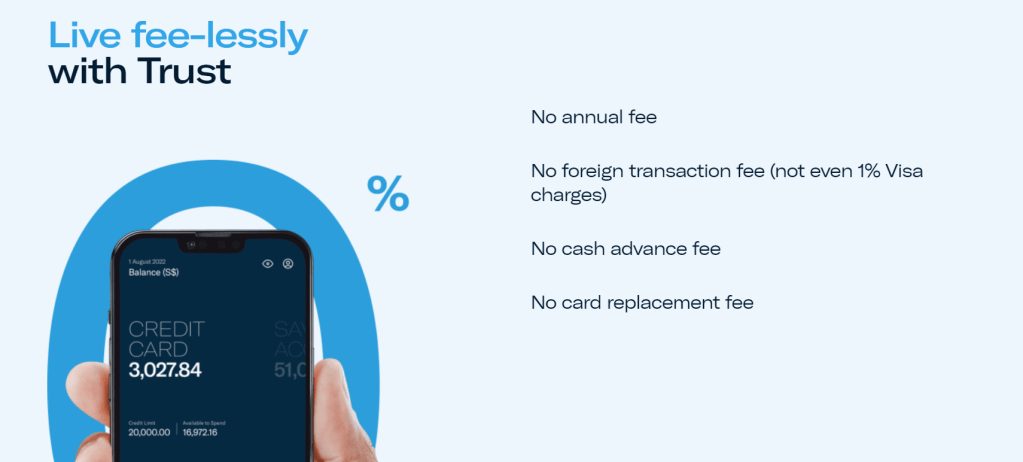
There aren’t any monthly fees
There isn’t any minimum balance
There isn’t any minimum period to close the account and hence an account closure fee
There’s also no card replacement fee (That’s one good thing)
Cons
Online only, not too sure about the customer service and customer care
Not sure about the service recovery
Not sure about how well they are protected in terms of security and how they manage fraud/compliance-related issues
Not sure what’s the target market.
Conclusion
Overall, it has decent rewards in terms of account-related perks and interest rates. However, I still feel like they can do more to offer a unique selling proposition. I just can’t see their deviation from their own Fair Price Group which is very local in this sense. I’m not too sure what they really want to achieve from this digital bank license.
However if it fits your bill and Fair Price is your go-to supermarket, why not? Also, If you are comfortable with online-only service as well as getting another account to remember that you have. I still think it is a 3 out of 5 stars at this point in time.
Please sign up using my referral code “MREC9F7G” at Sign Up here at Trust Bank. Thank you in advance for keeping the lights running for this blog.
By now, many of you would have known that the SSB for November hit an all-time high from all the blog posts. However, only those of you who know know. Those who don’t, have no idea at all. In this period of the internet world, word of mouth can actually be less efficient.
Year 1 (3.26%) vs 10 Year Avg (3.47%) for the tranche of SBNOV22 GX22110A
Indeed, that is pretty sweet but someone else’s gain is someone else’s loss. The mortgage rate for floating homeowners might be a shitty time to come. I’m not sure but perhaps there may be some level of concerns in the Singapore private markets soon? Especially for those who rode a tight line to take to upgrade and stretch out their finances. That’s a discussion for another article.
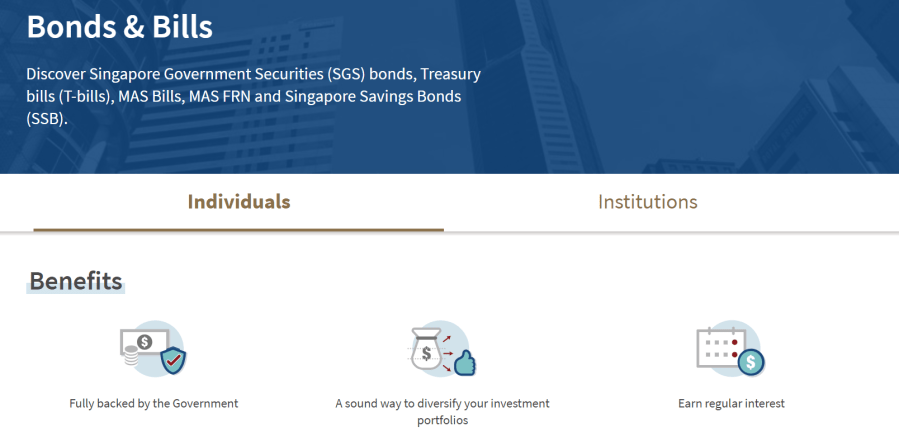
Meanwhile, what is probably better than the SSB, is the Singapore Treasury bonds. The ones that come in every two weeks will be the 6 monthly Treasury bond if you do not wish to lock in the rates for 10 years. (It doesn’t mean SSB will be illiquid. It just means the rate will stay constant for 10 years)
Treasury bills – 6 months for the previous tranch was offered for SGD 4.6 billion,
Life is very different for everyone. Every nook and cranny is different for each one of us. Eventually, that moulded all of us very differently. (i.e. How do we react to certain situations? How we seemingly lose common sense at certain things. With those things in mind, we can then empathise with others in their situation. While we may focus on how others are lacking, in the same sense we also need to be patient with others.
It is very easy to fall into the trap of looking at others and as always the grass is greener on the other side. (Until you reach the other side) Let me just sum it up. Only a small proportion of people get it lucky, they get the best of both worlds – What is rosy is also what is the true portrayal of their lives. The rest of them is living the beautiful lie (It doesn’t always come easy)
I can only speak from my own experience and while things were rosy. I had the opportunity to enjoy work and make good money while doing so. So, many times I try to look toward others with more empathy. Managing your own expectations is the hardest and because we all have our own aspirations, it often leads to less than expected results. However, we should always hold our heads high. Bite the bullet and move on. Sometimes pacing, slowing down before searing forward again. Easier said than done.
All of us are different and I do implore that no one look at other portfolios at 1 million, 500k or 250k at an envious level. Rather, look at things from a goal perspective and practicality. After all, everyone’s starting point is different. Look toward the end goal. Never give up and remember it is never too late to start.
One have to manage yourself as well as manage your own expectation. Every situation is different. Sometimes just purely managing time and break is not sufficient. We are built this way, some stronger than the other but lacking in other atrributes. Similar to thr concept of there are no perfect systems, there are no perfect human being. Behind the scenes, do you not think that those who seem fine has it easy too?
It is very similar to investing where everyone’s starting point is different. Today, I am lucky to have additional funds to explore and invest. Some may have just start while others may be struggling with debts or even many other issues.
I am glad I had basic financial knowledge and I understand some thing better than others.
Don’t see it as a hind or head start. It always start with an idea or a dollar. Be confident, no one else should tell you how you should be.
Remember you are not alone. Find support and community that are of like-mindedness
Singlife is offering up to $35 when you sign up for Singlife Account and their Singlife Grow. I’ve been following them for a while now and I realised that they have been promoting their GROW ILP account. I’m not sure if it took off well but given how there is marketing dollars to promote seems like it is encouraging a higher take up rate. To get the $30 from grow, it takes very little effort. If you are an existing Singlife Account, you will still qualify for the Singlife Grow reward as long as you have never applied for Grow portfolio before. Just take note to use the code to get your credits – “ki02dAhi”
The new scheme and promotion
There isn’t a lock-in period for your funds, and you can withdraw without penalty but it seems like there is a cap at S$20,000 per account per day so do take note.
The interest mechanic
On top of the sign-up gift, you also get 0.5% p.a. additional returns for your Singlife Account when you set up your Grow portfolio which is a nice cherry on top of the sign-up bonus. This gives you 1.5% p.a. on your Singlife Account for the first $10,000.
Not to mention that if you complete the $500 spending per month, you get an additional 0.5% p.a. and that makes it 2.0% p.a. on your Singlife Account for the first $10,000.
The Additional Perks
As all promotion goes, do some form of diligence and check out the Terms and Conditions to understand what you are putting your money into. Read it here: Terms and Conditions
The Cash Mechanic goes like this.
a. If you are not an account holder, sign up using this code ki02dAhi + order and activate the Singlife debit card to get a S$5 sign up bonus
b. If you are an existing customer then check GROW out.
Sign and apply for your first GROW policy using this code ki02dAhi + Fund your first GROW policy with a minimum of S$1000 to get a $30 sign up bonus.
In short, if you are a new customer, your max benefits will be S$35 and if you are an existing customer, your max benefits will be S$30.
The Real Deal, GROW ILP (Investment Linked Plan-ILP)
Without doubt, I scrutinise at the term ILP. Personally, I have terminated 2 ILPs that I bought some time back without knowing what I was going into.
Singlife Grow is primarily an investment ILP with very minimal insurance. You don’t have to pay high upfront commissions nor high assurance charges, and no lock-in period for your funds. However, I’m not quite sure if there is a fund switch function and what the bid-offer spreads are like.
Singlife Grow is more of a hybrid robo-insurtech /advisor perhaps and I can’t really classify them under any sorts but for sure they are in the Insurance industry so hence the term ILPs. They are not the typical ILP which loads the consumer even before the investing starts so that’s a plus.
However, do take note of the investment risks so it can go both ways and there’s no guaranteed returns.
I understand that the fund managers who will be managing your funds will be from Aberdeen Standard investments
They are also under ESG (Environmental, Social and Governance) which is a big thing these days as people approach sustainable investing.
Coverage will be 101% of Net premium or Account value (In the event it has gone up much higher)
Fees will be 0.25% per quarter of the account value. (Management Charge)
No Cost of Insurance (Excellent)
Some important information to note:
Singlife Launches Member Get Member Programme, Rewarding New and Existing Customers S$35 for Every Referral
Benefit
All referrers and referees receive S$30 when the referee signs up for Grow, and S$5 when the referee creates a Singlife Account and activates their Singlife Visa Debit Card. With no limits to the number of referrals, customers can continue to refer and receive more rewards.
The Grow ILP – Investment Linked Plan
Singlife’s Grow is an Investment-Linked Policy (ILP) with portfolios managed by Aberdeen Standard Investments. Accessed through the Singlife App, customers can manage, save and invest simply through a single interconnected platform with absolutely no lock-ins. For more information on Grow, visit https://singlife.com/grow/.
The Flexibility
The Singlife Account continues offering the same flexibility customers desire with no lock-ins or withdrawal fees, and better peace of mind. For more information about the Singlife Account, visit https://singlife.com/manage/. However last I tried, there is a cap of S$20,000 limit of transfer out per account per day so do take note.
The physical card
The Singlife Account is Singlife’s flagship everyday insurance savings plan that comes with a free Visa Debit Card, carrying no FX fees for foreign currency transactions.
The protection by SDIC
The Singlife Account and Grow are protected up to specified limits by Singapore Deposit Insurance Corporation (SDIC).
Disclaimer
This is not a sponsored post. This is purely my own opinion after using their service and/or products. If you like what you are seeing, do remember to check they out and do your diligence. There is no one size fits all investment strategy. Just take note to use this code to get your credits – “ki02dAhi“
Now, if what I am sharing does resonates with you, do use my referral codes here at Referral and Recommendations














 Lifejourney