
SNACK by Income – Microinsurance for the public

Revisiting a tech online portal that Income has developed over the years. It is not a great app since it wasn’t developed fully in my opinion but it does dole out a nice reward over time. It also helps to supplement whatever insurance that I currently have as a risk transfer.

Why Insurance?

Let’s face it. Everyone needs to transfer their risk and that is a fact. Whether it is a term or a whole life plan, is up for debate but no best answer. You need health insurance, life insurance, disability insurance, travel insurance, car insurance, and the list goes on. The challenge to DIY stuff is that although it comes cheap you have to figure out how to do that on your own. Nothing wrong with that but it comes in as a pain when you don’t have time to manage those stuff.

Try Microinsurance

Personally, I feel that it is fine to try out a cheaper alternative to insurance just to get yourself covered at the lowest cost possible. SNACK is by Income and they did not have this concept of microinsurance. I find it appealing personally coming from someone who understands how these things work. It kind of supplements what I have existing.

At least they try to speak the millennial language. Next, I find that with such low-cost products – There will be fewer barriers to entry. The difficulty in this solution is to educate people. It is much easier to say that it is complicated than trying to find out what this is all about.

Once you sign up online and register the amount you can commit daily, every document will be sent to you via email or digitally. Quite simple.


There are 4 ways you can choose to buy insurance (Choose 1 or whatever you need but the auto-invest is the one that gives out e-CapitaVouchers):

a. Critical Illness

b. Personal Accident

c. Life Insurance.

d. Investments – There is a new weekly limit for the RSP style on the Asian Income Fund. There’s only one fund and I also believe the NAV versus the Sell (Also known as bid price) will be different from the Buy (Ask price) That’s something I don’t quite like about insurance firms. They need to do away with this (With the fact that they tell customers there’s no front-end or back-end loading). This itself is the spread.

Recently, there’s been a monthly mission and a single top-up mission that one has to invest and hold for a month before the team releases e-CapitaVouchers via email on fulfillment. It’s not too bad and ranges from a cashback of approximately 5-8% depending on the investment amount.

The cons is that the system is not great. You can’t do partial withdrawal, there is only one Asian Income Fund, and it comes with a buy-sell spread (Fees and management fees from the fund). Also, the max investment is $1000 weekly so there’s a bit of micro-management and exploring how bad the app is to figure out how to not tweak the limits any period as the change actually reset the period.

Missions also are limited to 28-29 days – so if you miss a day, you miss out on the big prize. The challenge prizes have also been reduced over time but that is expected.

Be careful since it is still an investment but no harm in trying after exploring and figuring it out.

You can also trigger these daily costs from a few parts:

a.  Redeeming deals or paying for meals using a VISA card.

b. Commuting by bus, train, or cab and paying for it using a VISA card.

c. Through retailing and purchases using a linked VISA card.

d. Shopping for groceries using a linked VISA card.

e. Through entertainment and paying using a linked VISA card.

f. Topping up petrol and paying using a linked VISA card.

g. Pay your utilities and pay using a linked VISA card.

h. Activate your Fitbit app and fulfill your daily steps.

You may be thinking what happens if you hit every objective. There is a limit to the premiums charged to your credit or debit card depending on the weekly cap you’ve set up. Once you’ve hit this weekly cap, SNACK will no longer charge you premiums when you complete lifestyle triggers and you will not be issued any more policies for that week.

The minimum amount daily you can set is $0.30 and you can add on as many triggers as you wish.

There is also a cap on each insurance segment:

a. For Personal Accidents, the cap is at $100,000

b. For Life Insurance, the cap is at $200,000

c. For Critical Illness, the cap is at $200,000

These insurance are known as non-participating policies so the moment you stop paying for these, the coverage will stop. To me, it is a stop-gap kind of coverage and at an extremely low cost. If you are looking at the full suite, take time to understand and learn. You will definitely benefit from the knowledge and to suss out your new insurance agent. Whether they are in it for the long term or to hit and run. We will never know unless we experience and have the basic knowledge.

Disclaimer

This is not a sponsored post. This is purely my own opinion after using their service and/or products. If you like what you are seeing, do remember to check them out and do your diligence. There is no one-size-fits-all investment strategy or general rule for your every life. Join my telegram group to find out more about deals and join in the community to connect for ideas: Life Journey Telegram

If you like what I am sharing or if it resonates with you, do use my referral codes here at Referral Services

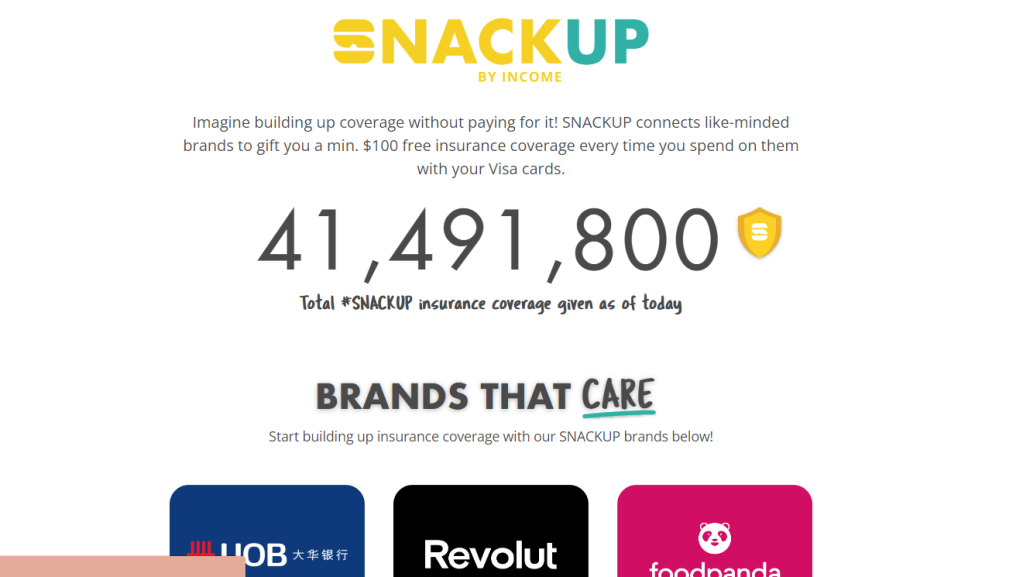
The pictures were taken from the SNACK website for this article. If you need a referral code, please use my referral code “PAU4055” to sign up at https://www.snackbyincome.sg/ to find out more.

Being Micro (Understanding your Portfolio)

When discussing the portfolio of Financial Planning, it is common to waive it off if you have no interest in it or talk about investments only. Like any broken recorder, the basis of Finance Literacy is fundamental however you dislike it.

Let me put it on a storyboard – As a child or if you have a child, you would want them to learn skills from a young age. (NO! I am not talking about enrichment). Here I am talking about pure survival skills like swimming, psychomotor skills, being literate, learning to drive when you are older, learning simple skills like dealing with disappointment, etc.

Similarly, financial planning is no exception to life skills. Imagining a pyramid, the top layer is not investments but insurance. Meaning risk transfer. Now, skip the boring part of insurance planning. There are a few alternatives to cheaper insurance coverage.

One of them is actually SNACK by Income. Yes, Income Insurance.

Don’t miss out now because there’s a good deal going on at the moment.

The Promotion

Here’s $50 for you to start your investment journey!

All you need to do is:
1. Download the SNACK by Income app (https://income.sg/dl-snack)
2. Enter my referral code “PAU4055” and tap on SIGN UP
3. Complete your SNACK account creation with MyInfo
4. Start SNACK Investment and ensure that you have boosted Investment! (Refer to steps 1-4 here: https://income.sg/si-start)

Get your complimentary $50 investment credits in your portfolio the following week!

Technically, it can be termed as an ILP (Investment Linked Plan) and honestly I am not a big fan of it. But you can exclude the investment option if you don’t wish to. However, for a start, you probably should do the investment portion until you get the signup rewards.

The Limit

I use the personal accident, critical illness and life insurance portion to supplement my current insurance. In any case, there is a maximum that one can be insured and it starts from $0

Life – $200,000 coverage

Accident – $ 100,000 coverage

Critical Illness – $200,000

How it Works

How this micro insurance work is that:

  1. You need to set your lifestyle activities for different classes of insurance coverage and investment (if any). For each activity that is fulfilled, a new policy will be created and added to your total coverage. In this step, you can also set a daily cap so that you don’t spend more than $0.30 (for example) per day.
    • Food & Drinks
    • Transport
    • Retail
    • Groceries
    • Entertainment
    • Utilities
    • Petrol
    • Steps
  2. Then you set your activity source. These are the ones that measure your activities such as step or visa credit card if you spend on certain categories.
    • Apple Health
    • Burpple
    • EZ-link
    • Fitbit
    • Garmin
    • Visa
  3. Then set your weekly cap – This is for the investment cap. Up to one to decide
    • You will need to have your investment objective assessed such as CKA – Customer Knowledge Assessment
    • Risk Profile.

There you go and your SNACK account will be set up for you. That said, you can redeem the fund units anytime and can stop using the insurance app anytime you want.

I get that it takes a while to get used to it but you need some time to get used to it as it is pretty automated.

If there are some brands which interest you, you can also spend and get additional coverage from them as well. Once in a while, they will run some promotional campaigns and you can get additional investment credits. So far, luck has been on my side, I have collected more than a couple of hundred in investment funds terms. Like any insurance, this is pretty efficient for an ILP since I investment directly into a fund I am comfortable with.

Disclaimer

If you decide to sign up with SNACK, do remember to use my referral code: https://income.sg/dl-snack and my referral code PAU4055.

If you like what I am sharing or if it resonates with you, do use my referral codes for other services at Referral and Recommendations

These pictures were taken off the Endowus website for reference.

SNACK – Microinsurance

As I have said, I am a firm believer of insurance but not a firm believer of agents. I am of the mind that there are invested interest. Even the most honest guy needs to earn a living but I have yet to find anyone who is able to pass my test. More often than not, I tend to DIY on my own so most of my plans are generally bought online. The exception is that during the early years, agents used to manage those that I bought.

Why Insurance?

Let’s face it. Everyone needs to transfer their risk and that is a fact. Whether it is term or whole life plans, it is up for a debate but no best answer. You need health insurance, life insurance, disability insurance, travel insurance, car insurance and the list goes on. My only grip is that DIY stuff comes cheap but you have to figure out how to to that on your own. Nothing wrong with that but it comes in as a pain when you don’t have time to manage those stuff.

Try Microinsurance

Personally, I feel that it is fine to try out a cheaper alternative of insurance just to get yourself covered at the lowest cost possible. SNACK is by Income and recently introduced this concept of microinsurance. I find it appealing personally coming from someone who understand how these things work. It kind of like supplement what i have existingly.

I think that the Income branding is starting to change and this helps with the brand image. At least they try to speak the millenia language. Next, I find that with such low cost products – There will be less barrier to entry. The difficulty in this solution is to educate people. It is much easier to say that it is complicated than trying to find out what this is all about.

Once you sign up online and register the amount you can commit daily, every document will be sent to you via email or digitally. Quite simply, I would say.

They are 3 ways your can choose to buy insurance from (Choose 1 or whatever you need):

a. Critical Illness

b. Personal Accident

c. Life Insurance.

You can also trigger these daily costs from a few parts:

a.  Redeeming a deal from Burpple or pay for meals using a VISA card.

b. Commuting bus, train or cab and pay for it using a VISA card.

c. Through retailing and purchases using a linked VISA card.

d. Shopping for groceries using a linked VISA card.

e. Through entertainment and paying using a linked VISA card.

f. Topping up petrol and paying using a linked VISA card.

g. Pay your utilities and paying using a linked VISA card.

h. Activate your fitbit app and fulfilling your daily steps.

You may be thinking what happens if you hit every objective. There is a limit to the premiums charged to your credit or debit card depending on the weekly cap you’ve set up. Once you’ve hit this weekly cap, SNACK will no longer charge you premiums when you complete lifestyle triggers and you will not be issued any more policies for that week.

The minimum amount daily you can set is $0.30 and you can add on as many triggers as you wish.

There is also a cap on each insurance segment:

a. For Personal Accident, the cap is at $100,000

b. For Life Insurance, the cap is at $200,000

c. For Critical Illness, the cap is at $200,000

These insurance are known as non-participating policies so the moment you stop paying for these, the coverage will stop. To me it is a stop-gap kind of coverage and at an extremely low cost. If you are looking at the full suite, take time to understand and learn. You will definitely benefit from the knowledge and to suss out your new insurance agent. Whether they are in it for the long term or to hit and run. We will never know unless we experience and have the basic knowledge.

Disclaimer

This is not a sponsored post. This is purely my own opinion after using their service and/or products. If you like what you are seeing, do remember to check they out and do your diligence. There is no one size fits all investment strategy.

If you like what I am sharing or if it resonates with you, do use my referral codes here at https://atomic-temporary-178675883.wpcomstaging.com/contact/ for the services.

The pictures were taken from SNACK website for this article. If you need a referral code, please use my referral code “PAU4055” and both of us will be rewarded with additional $500 coverage for personal accident. Visit here https://www.snackbyincome.sg/ to find out more.
CPF (Assisting your Retirement?)

Whenever we touch on the topic of CPF, also known as Central Provident Fund (Pension Fund – The Europeans and Americans call it), people get kind of edgy and upset. What I do observe is that mostly a certain group of people is really anti CPF. The first group is those who are anti-government, not fueling anything here but just a general consensus. The second group is the retirees or about to retire folks who didn’t have a decent education (At that point in time, it wasn’t necessary to have the paper qualifications) and the last group is the self-proclaimed Warren Buffet who claims to beat the market.

The Central Provident Fund

The CPF in my opinion, is something of a great system. There are certainly flaws to it but in my view it is the perfect, AAA grade, higher yield returns that can supplement all our retirement fund. There are certain risks but There are no investment tool has no risk in reality. I finally conclude that as a result of these 3 group of people, these are the reason why so many people dislike the CPF system.

The AAA rating

a. Unfortunately, it is a complex system – You need to read up and understand how it works to appreciate the system

b. Inflation rate is here to stay hence the increase in the minimum sum yearly

c. No one is taking your money away.

d. No. There is no crystal ball. Statistically, it is proven that you can never win 100% of the time. Anyone who have tried or attempted to invest their monies will know that there is no clear strategy out there but a lot of hard work so you will not be able to beat the benchmark all the time.

e. Good quality investments and yields are hard to find these days. Perhaps it is a reality check and time to reflect about strategies as well as accepting facts and the markets

Understanding what CPF is about

When I first explored CPF, it was when I was out of school into my first job. At that time, CPF seems like a Goliath – You think you know but eventually, you slowly find out stuff which you never know before and for a long period of time I put off reading up more about them. It was many years back that I started reading financial blogs and it became like a ritual. I’ll do that almost any other day.

Back in those days, there were less bloggers so you will still need to dig deep to find out how stuff works. Then came Technology advancements, social media and super apps/content apps. I also discovered a few more bloggers who actively shared about CPF. One one those whom I follow really closely is 1M65. His is a well-known blogger for CPF and he developed his own strategies around what the CPF has been doing for many years.

Life Cycle

1M65 is really about having a million in your CPF by 65 years old. Depending on how you look at it, he is preaching a 4M65 these days and base on his concept – I do think that is possible if you start really young. Anyway, his idea about have these sum of money is really to get you thinking about your own retirement early, not just when you are in your mid stage or even late stage of your life cycle.

Everyone is different

Most importantly, everyone is different. There is no need to look at it in the form of a showboat or saying that it is impossible. Being open and understanding how these people are doing do help yourself to be ready for retirement – You are doing your next generation a favour so that they will not fall into the sandwich class or fall in the same cycle again and again. Of course, teaching the value of money to the next generation is something that needs to be worked on as well. It’s not like they were given a sum of money to deal with in life.

Some people actually worked two jobs or even saved excessively so that they can put all their money into retirement. Again, lifejourney preaches about having your own quality of life. If you need to feel like you have to give up everything just to be thrifty (It is a really thin line to term it as miserly), then you would most likely have to re-think your strategy.

The Practical Approach

There are a lot of concepts that you can read about but most of them come from a theory. Personally, I don’t really like to dissect those as they are so technical and heavy. Most importantly, it is extremely boring to put them down in words and executing them is really the best way to practice

Stock market digital graph chart on LED display concept. A large display of daily stock market price and quotation. Indicator financial forex trade education background.

As 1M65 says, you can hate who or whatever but don’t hate free money. Initially, it sounded like a money grubber statement but eventually I came to realise that, it is really free money. If you have no plans to be an entrepreneur, there is a few things you have to take note of in CPF. Yes, I am sorry but everything has to start from the basics.

My View on CPF

a. My biggest take on CPF is to compound the interest. The more you have, the greater the growth. The younger you fill up your CPF account to accumulate interest, the faster and bigger your pension fund will grow.

bi. If you are below 55 years of age – Your first $60k in CPF will gain an extra 1% p.a. (This is capped at S$20k in your OA) The current base Ordinary Account (OA) is 2.5% (3-month average of major local banks’interest rates, whichever is higher)

bii. For most people, the next S$40k will most likely be in your Special Account (SA). For others who are still building your SA, that will be whatever that is in your MediSave Account (MA). The base rate for your SA and MA is at the current floor of 4% p.a. (which is also the 12 month average yield of 10-year Singapore Gov Securities – 10YSGS)

My Tips:

Your CPF interest is computed monthly based on the lowest balance for the month. This means that for interests paid out on your CPF accounts in Year 2020, the interest amount is based on what was captured monthly, compounded and only paid out to you in full before 1st Jan of 2021. (This is subjected to changes if you have transactions every month)

c. As much as possible, you have to try your best to hit the minimum sum as early as you can. (Combined OA and SA)  Once you manage to do that, you do not need to worry about the annual increase in minimum sum that is subjected to inflation.

My Tips:

Don’t lose faith if you have not or still very far from this. Everyone starts from $0. Let the small actions and do up your checklist one by one in order to build the financial confidence. Everyone is different – it is the end goal that matters.

d. Depending on your circumstances, you can choose to invest your CPF OA money after the S$20k accumulation. Similar to cash, have a long term goal and build your portfolio. Good companies and investment ideas doesn’t come easy. You have to make sure what you invest is more calculated risk. There is a risk to everything.

My Tips:

Don’t be affected by market noise. My tip is to buy when there is a price drop if the investment moat for the company still makes sense. (but always do your own diligence) You can also have different pockets of funds so that when there are opportunities or if there is a correction, you can be ready to enter the market. The rule is to always stay invested.

Summary

In Summary, CPF is not the perfect solution but a supplement of your retirement goals. In this aspect, we are responsible for our own money and retirement. No one else will take care of your money as much as you will do.  Only you will know your own financial situation. The question is to ask to meet these financial goals is that if you can cut back on your lavish lifestyle or even saving more to add to your pool of funds. No one can coerce you to do what you do not wish to.

Disclaimer

This is not a sponsored post. This is purely my own opinion about CPF and retirement. If you like what you are seeing, do remember to check them out and do your diligence. There is no one size fits all investment strategy as usual

Do check out some of my referral codes for other services here at https://atomic-temporary-178675883.wpcomstaging.com/contact/ for the services.

The pictures were taken from CPF website for this article.